Brazilian CPF for U.S. Citizens: Exact Procedures From the U.S. and Inside Brazil
A Brazilian CPF (Cadastro de Pessoas Físicas) is a tax/identity registration administered by Receita Federal do Brasil and is available to Brazilian and foreign nationals, with no minimum age, whether living in Brazil or abroad. Two practical pathways exist for U.S. citizens:
Route A (from the United States): Foreigners outside Brazil are instructed by Brazil's official gov.br service portal to submit CPF requests through Brazilian consular posts abroad, generally via an in-person appointment (often after online pre-submission through e-Consular). Across major U.S. consulates, the core pattern is: generate the CPF registration form/protocol online, submit/upload documents per that consulate's process, then attend an appointment where the CPF is issued (often same day).
Route B (while physically in Brazil): gov.br's CPF service describes CPF registration as available online and through in-person networks, including Receita Federal units, partner “PAV” points, and “unidades conveniadas” such as banks and the post office; registration is free except when done at certain conveniada locations that charge a small service fee (R$ 7,00). Document requirements inside Brazil center on an official photo ID and (when necessary) a birth or marriage certificate to evidence parentage and other civil details.
Two recent policy shifts matter for foreigners: (1) multiple consulates cite Joint COCAD/COGEA Ordinance No. 53/2023 as requiring foreigners abroad to present CPF requests at Brazilian consular offices, via in-person service; and (2) some U.S. consulates state that starting January 13, 2025, foreign CPF holders with an address abroad must complete an annual “re-registration/update” via the Receita Federal mobile app workflow (selfie + passport).
What exactly is the CPF and why do foreigners need it?
The CPF is the tax and identity registration administered by Receita Federal do Brasil. It links contracts, bank accounts, taxes, and purchases to each person. Without it, most financial and government procedures in Brazil are blocked.
The Receita Federal requires it from foreigners because it tracks economic activity in Brazil: opening accounts, signing rental contracts, enrolling in universities, buying SIM cards, activating Pix, etc.
The CPF is not mandatory for foreigners traveling to Brazil for tourism, shopping, or buying online.
Annual re-registration: All foreigners with a CPF must complete an annual re-registration through the official “Receita Federal” app (Android/iOS). In effect since January 13, 2025.
Download the Receita Federal app ↗ | gov.br/receitafederal – Meu CPF ↗
Who must register for the CPF?
- Residents in Brazil who must pay taxes or manage residency in the country (the Brazilian CPF is key).
- People with temporary or permanent residency who wish to join the Brazilian tax system.
- Nationals of Mercosur and other countries with residency agreements with Brazil who want to reside legally.
- Anyone planning to stay in Brazil indefinitely and who has registered assets in the country.
- Those affiliated with the social security system or beneficiaries of INSS.
- Foreigners in Brazil seeking residency for specific purposes (study, work, etc.).
View legal list of who needs a CPF
I – residents in Brazil who are part of the passive side of a main or accessory tax relationship, as taxpayer or responsible party, as well as their legal representatives, under federal, state, district or municipal tax law;
II – residents in Brazil or abroad who: (a) carry out real estate operations of any kind in Brazil; (b) hold bank, savings or investment accounts in Brazil; (c) operate in the financial or capital markets in Brazil; or (d) hold in Brazil assets subject to public registry or specific cadastre;
III – are 12 (twelve) years or older and are registered as dependents in the Annual Income Tax Return (DIRPF);
IV – whose registration is required by federal, state, district or municipal public administration bodies;
V – registered in the civil registry of natural persons in Brazil at the time of issuance of the birth certificate; or
VI – affiliated as insured with Social Security or applicants for any benefit from the National Social Security Institute (INSS).
Primary official sources
The items below prioritize official primary sources (Receita Federal, gov.br service portal, and Brazilian consulates in the U.S.). Dates shown are the “published/updated/last modified” dates displayed on each page.
| Official source (purpose) | Page date shown | URL |
|---|---|---|
| gov.br service: “Inscrever no CPF” (overall eligibility, channels, fees, documents) | Last modification: 15/12/2025 | gov.br/pt-br/servicos/inscrever-no-cpf |
| gov.br service: “Inscrever no CPF no exterior” (rules for Brazilians abroad vs foreigners; document list; free) | Page shows steps; time not estimated | gov.br/pt-br/servicos/inscrever-no-cpf-no-exterior |
| Receita Federal: “Inscrição CPF Estrangeiro” (online foreigner registration form) | Form page; no date in header | servicos.receita.fazenda.gov.br/.../InscricaoCpfEstrangeiro |
| Receita Federal: “Meu CPF” overview (eligibility incl. foreigners; no minimum age; service links) | Page contains service hub content | gov.br/receitafederal – Meu CPF |
| Receita Federal: Print CPF registration proof (Comprovante de Inscrição) | Form page; no date in header | Consulta Impressão Comprovante |
| Receita Federal: Print CPF status proof (Situação Cadastral) | Form page; no date in header | Consulta Situação CPF |
| Receita Federal: “Atendimento presencial” (appointment link; conveniados list) | Updated: 26/11/2025 | Fale Conosco – Presencial |
| Receita Federal: “Atendimento por e-mail” directory by region; limits for foreigners in transit with only passport | Updated: 13/02/2025 | Fale Conosco – E-mail |
| Consulate General of Brazil in New York – CPF (foreigner procedure; apostille note for non‑U.S.-issued documents) | Updated: 21/08/2024 | Consulado Nova York – CPF |
| New York consular fees page (CPF service “Gratuito”) | Updated: 21/08/2024 | NY – taxas consulares |
| Consulate General of Brazil in Miami – “CPF – Information for foreigners” (mandatory passport + birth certificate; e-Consular; free; annual re-registration note) | Updated: 17/01/2025 | Consulado Miami – CPF foreigners |
| Miami consular fees page (“Emissão de CPF – Grátis”) | Updated: 26/06/2025 | Miami – tabela de preços |
| Consulate General of Brazil in Boston – “CPF – For non-Brazilian citizens” (email appointment; documents; Título de Eleitor instruction) | Updated: 19/11/2024 | Consulado Boston – CPF |
| Consulate General of Brazil in Los Angeles – “CPF for non-Brazilian citizens” (e-Consular upload; notary signature requirement; free) | Updated: 22/10/2025 | Consulado Los Angeles – CPF |
| Los Angeles consulate homepage (e-Consular appointment; CPF required for consular services from 07/03/2024) | On-page notice | Consulado Los Angeles |
| Consulate General of Brazil in Washington, DC – CPF page (foreigner docs; same-day processing; annual update note) | Updated: 15/01/2025 | Consulado Washington DC – CPF |
| Washington DC consular fees page (“Issuance of a CPF – Free”) | Published: 29/07/2022 | DC – consular fees |
Route A: Applying from the United States
Eligibility and who qualifies
Official guidance (gov.br services + Receita Federal's “Meu CPF” hub) indicates CPF registration is available to Brazilian and foreign individuals, with no minimum age, including residents and non-residents. For foreigners who are outside Brazil, gov.br explicitly directs that the request must be made at a Brazilian consular post abroad; multiple U.S. consular pages repeat this rule and cite Joint COCAD/COGEA Ordinance No. 53/2023 as the basis. Use the consulate that has jurisdiction over your U.S. address: Brazilian consulates.
Required documents (complete list, including originals/notarization/apostilles)
Across official sources, you should prepare a “baseline packet,” then check consulate-specific additions:
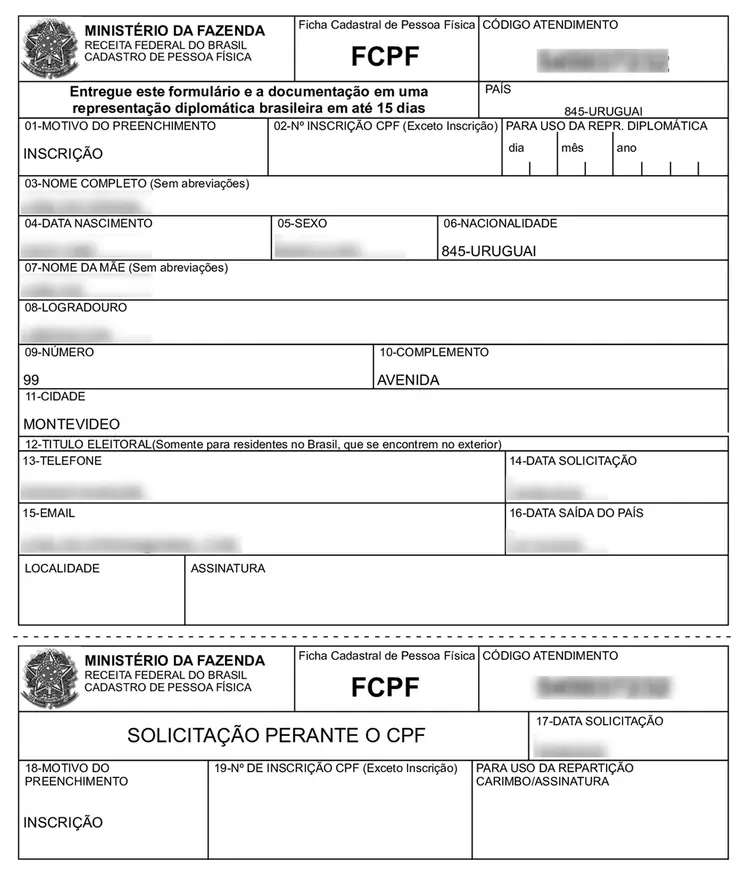
- Generated CPF request form/protocol (FCPF): gov.br and multiple consulates instruct you to complete the online CPF form and generate a protocol/form (FCPF), then sign it.
- Identification: Consulates list a valid passport as the primary ID.
- Birth certificate or marriage certificate: gov.br's “CPF abroad” service lists these for foreigners; several consulates require one (Miami makes birth certificate mandatory).
Originals vs copies: Some consulates require bringing original documents for verification at the in-person appointment after e-Consular pre-review. Washington, DC describes “original and copy” of a valid passport (and optional birth certificate to include parentage).
Notarization: Not always required; the Los Angeles post is explicit: after generating the FCPF, you must print it and sign it in the presence of a notary public.
Apostille / legalization: New York warns that if a supporting document was not issued by the U.S. Government, it must be “recognized,” including via apostille authorities in the issuing country. For most U.S. citizens using a U.S. passport and U.S. birth certificate, this typically will not apply; it can apply when presenting a third-country birth certificate or similar non-U.S. civil record.
Translations: For standard CPF issuance, U.S. consular pages do not uniformly demand translation of U.S. passport/birth certificate; requirements can vary by post—follow the specific consulate's CPF page.
Step-by-step application procedure from the U.S.
- Step one: Identify the correct Brazilian consular post and its submission channel. Use Brazil's consular network (gov.br) to find the responsible post for your place of residence, then use that post's instructions to submit via e-Consular (common) or email (Boston).
- Step two: Generate the CPF form/protocol online (FCPF). Multiple consulates instruct foreign citizens to fill out the online CPF form and generate a protocol/FCPF. Leave the “Título de Eleitor” field blank. Pop-up blockers must be disabled so the form/protocol can generate (per gov.br and consular instructions).
- Step three: Sign the generated form in the required manner. At minimum, sign the form; Los Angeles adds a notarization requirement (signature in front of a notary public).
- Step four: Submit documents through the post's required system and obtain an appointment. Several posts require submission through e-Consular, then after review you schedule an in-person appointment and bring originals. Boston directs foreign citizens to request an appointment by email, then attend with required documents.
- Step five: Attend the in-person appointment; CPF is issued. Washington, DC and New York state that CPF issuance occurs at the appointment; Washington, DC states same-day processing for in-person presentations.
Fees, payment methods, and processing times (Route A)
Fees: Official sources consistently describe CPF issuance as free through these consular routes (e.g. Washington, DC; Miami; New York; Los Angeles fee pages).
Processing time: Where stated, issuance at the consular appointment can be same day (Washington, DC); New York describes issuance at the in-person appointment after e-Consular review. Appointment availability is not standardized; lead time is often driven by how quickly you can secure a slot.
How CPF is delivered and how to retrieve proof
Consular pages emphasize that the CPF number is generated at issuance and appears on a receipt; store it safely. If you forget it, recovery is typically done in Brazil (consulate cannot retrieve due to tax-data secrecy). For proof of registration, Receita Federal supports: Comprovante de Inscrição no CPF and Comprovante de Situação Cadastral no CPF (CPF + date of birth). The old plastic CPF card is no longer issued in that format; consular guidance directs users to print the proof instead.
Route B: Applying while physically in Brazil
Eligibility and where you can apply inside Brazil
gov.br's “Inscrever no CPF” service states that Brazilian and foreign individuals, residents and non-residents, can apply. It describes multiple channels: online form submission, partner “PAV” points, email service, and a conveniada (authorized partner) network. Receita Federal's “Atendimento presencial” page explains that service is provided at Receita Federal units and PAV partner points, and that conveniados (banks, post offices, civil registry offices) also offer CPF registration and updating. Note: The Receita email directory states that “foreigners in transit in Brazil” who have only a passport as ID must seek in-person service; email remains available for certain other groups (e.g. MERCOSUR nationals, some diplomatic cases).
Required documents (originals/certificates; minors)
gov.br's CPF registration service describes:
- Official photo identification; and birth certificate or marriage certificate (or equivalent for foreigners) if the ID does not contain place of birth, parentage (filiação), and date of birth. Additional documents may be requested by the clerk.
- Ages 16–17: either the minor applies with photo ID, or a parent/guardian applies with the minor's birth certificate or photo ID plus the applicant's photo ID and proof of guardianship where applicable.
- Under 16: birth certificate or photo ID showing nationality, parentage, and date of birth; plus the applying parent/guardian's photo ID; plus proof of guardianship if applicable.
Step-by-step application procedure inside Brazil
- Step one: Choose the channel — online first, in-person at Receita Federal/PAV, or at a conveniada.
- Step two: If using the online foreigner form, complete “Inscrição CPF Estrangeiro” at Receita. Receita explains that online requests may be “conclusive” or “non-conclusive”; if non-conclusive, the system generates a protocol with instructions on how to proceed.
- Step three: If online is not conclusive (or you prefer in-person), go to an in-person channel. Receita Federal units and PAV points offer service; the “Atendimento presencial” page provides an appointment pathway and lists CPF services through conveniados.
- Step four: Receive your CPF number and generate proof documents as needed. After issuance, use Receita online tools for “Comprovante de Situação Cadastral no CPF” (CPF + date of birth) and “Comprovante de Inscrição no CPF” as needed.
Fees and expected timing (Route B)
Fees: gov.br states CPF registration is free, except when performed at “unidades conveniadas,” which charge R$ 7,00. Time: gov.br provides an estimated in-person waiting time (“até 15 minutos”) for certain channels but not a universal processing SLA. If your online submission is non-conclusive, you must follow the protocol's next steps.

Consulate differences and recent changes
Procedures differ among the major U.S. posts in three recurring ways: intake channel (e-Consular vs email), whether a birth certificate is mandatory for adults, and whether notarization/apostille steps appear in the standard path.
New York: e-Consular request (“CPF application (for foreign citizens)”), then in-person verification; CPF issued at appointment. Prominent document-recognition note: non‑U.S.-issued documents may require apostille/legalization before submission.
Miami: All documents must be submitted via e-Consular; valid passport and birth certificate are mandatory; service is free; page includes explicit annual “re-registration” instructions starting January 13, 2025.
Boston: Foreign citizens are directed to request an appointment by email and bring the FCPF plus required documents; foreign citizens must not fill the “Título de Eleitor” field.
Los Angeles: Requires e-Consular submission plus a notarization step (sign the generated FCPF in the presence of a notary public); issuance is free. The consulate homepage notes that all services are via prior e-Consular appointment and that CPF became a required identifier for consular services from March 7, 2024 (per Law 14.534/2023).
Washington, DC: Foreign citizens submit via e-Consular and appear in person; passport required; birth certificate optional (to include parentage); in-person CPF registrations are processed the same day; annual foreigner update requirement starting January 13, 2025 is published.
Two trend-level changes: (1) Post-2023 tightening for foreigners abroad — multiple consulates cite Joint COCAD/COGEA Ordinance No. 53/2023 for the rule that foreigners abroad must submit CPF requests at Brazilian consular posts via in-person service. (2) 2025 annual update for foreign CPF holders abroad — at least Miami and Washington DC state a January 13, 2025 start date and an app-based selfie/passport process for annual updating, plus error escalation instructions.
Special cases, pitfalls, and troubleshooting
Special cases
- Minors: Brazil's gov.br CPF service provides explicit checklists for minors under 16 and for ages 16–17, including when a parent/guardian may apply and when proof of guardianship is required. Consulate pages add their own requirements (e.g. Boston requires minors under 16 to present a document showing parents' names and attend with parents/legal guardians).
- Dual citizens (U.S.–Brazil): If an applicant is also Brazilian, consular instructions diverge (electoral-registration/voter-ID fields become relevant). Washington DC's CPF guidance distinguishes Brazilians from foreigners and notes voter ID (“Título de Eleitor”) requirements for Brazilians; foreigners must leave that field blank. Where Brazilian electoral documentation arises, the relevant institution is Brazil's electoral authority (Tribunal Superior Eleitoral).
- Applicants without a U.S. SSN: None of the primary Brazilian issuance pathways require a U.S. Social Security Number; the foreigner-facing forms and consular checklists focus on passport/identity documents and civil records.
- If you forgot your CPF number: Multiple consulates emphasize that recovery cannot usually be handled at the consulate due to tax secrecy; the person must resolve it in Brazil via Receita Federal, potentially through a representative using a power of attorney. Some consulates specify that foreigner POA must be notarized, apostilled, and translated by a sworn translator.
- Foreign CPF annual “re-registration/update” (2025): Miami and Washington, DC state that starting January 13, 2025, foreign CPF holders with an address abroad must update/re-register annually through the Receita Federal app workflow (enter CPF + DOB, take a selfie with passport visible, then fill requested data). If inconsistencies prevent completion, Washington DC describes emailing the consulate with screenshots and ID page; Miami describes emailing a specific address with a screenshot of the error.
Common pitfalls and likely rejection/deferral reasons
- Pop-up blockers prevent form/protocol generation — official sources warn that browser pop-up blockers must be disabled or submission will fail.
- Filling “Título de Eleitor” as a foreign citizen (should be blank) — U.S. consular pages repeatedly instruct foreign citizens not to fill that field.
- Missing birth certificate where the post requires it — Miami explicitly lists valid passport and birth certificate as mandatory; missing it risks non-processing.
- Not meeting Los Angeles notarization requirements — LA instructs that the generated FCPF must be printed and signed in the presence of a notary public before submission.
- Using foreign (non‑U.S.-issued) civil documents without proper recognition — New York warns that documents not issued by the U.S. Government must be recognized (including apostille pathways).
- Trying to use the “email CPF service” as a tourist in Brazil with only a passport — Receita Federal's email directory clarifies that foreigners in transit with only a passport must seek in-person service.
Check status: Situação Cadastral. “Pendente de Regularização” / “Suspensa” / “Cancelada” have specific meanings (e.g. tax filing, death); clear any tax debt before relying on CPF for new procedures.
Importance of the CPF for residency in Brazil
For foreigners who want to reside in Brazil indefinitely, the CPF is a requirement that allows them to carry out banking transactions, register property, and meet tax obligations. Those with temporary or permanent residency must also be registered for the CPF, especially if they plan to conduct economic, work or educational activities in the country.
For nationals of Mercosur and other countries with residency agreements with Brazil, the Brazilian CPF is essential under those agreements, which allow you to live and work legally in Brazil.
Meeting the requirements
Each CPF application must meet the specific requirements set by the Brazilian government. Those applying for a visa or residency permit must obtain the CPF before the end of the 90-day period after arrival. For family reunion residency or study/work permits, having the CPF helps with legal and tax integration in Brazil.
For those seeking permanent residency in Brazil, the Brazilian CPF is one of the first administrative steps. Those who already have a background certificate or have lived in Brazil in the last 12 months must submit the CPF application when applying for any other residency permit.